

AI workshop offsite agenda for teams rolling out agents
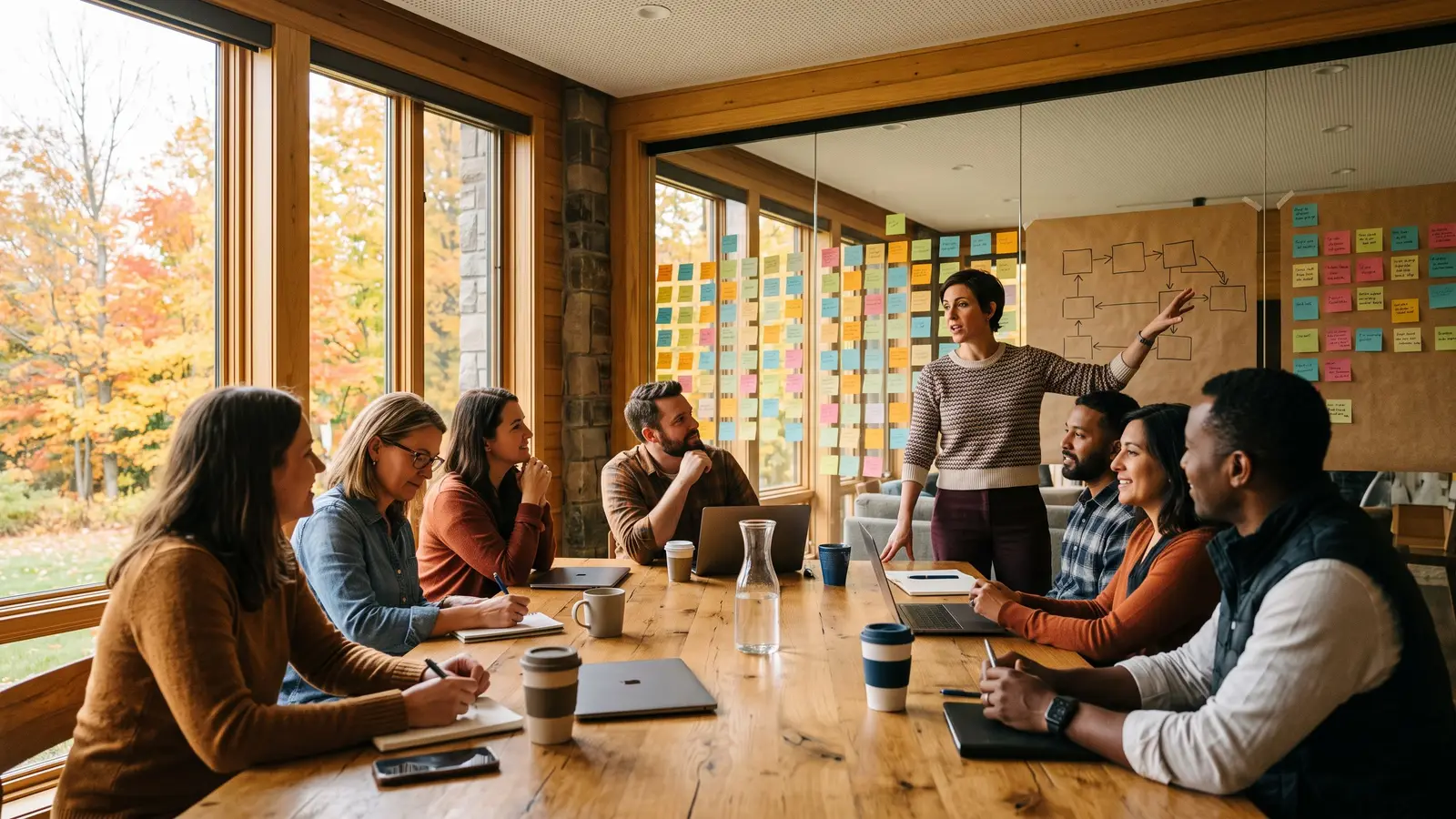
An AI workshop offsite agenda for a team rolling out agents and bots should spend almost no time on the tools. The useful work is human: agreeing what stays with people, mapping real workflows together, pairing colleagues across functions, deciding guardrails, and building enough trust that someone will say out loud what the bot got wrong. Below is a two-day agenda with timings, facilitation notes, and the 30-day follow-through that makes it stick.
Why this is not a training day
The bots are already in the room. Glean's 2026 Work AI Index, a survey of 6,000 digital workers, found the average worker now collaborates with three AI agents alongside human teammates, has sent a bot or digital twin to one in six meetings (17%) instead of attending, and AI note-takers join nearly a third of meetings. Just over half (52%) find it easier to collaborate with AI than with human coworkers.
That is not an argument against the tools. Gensler's 2026 Global Workplace Survey of more than 16,400 office workers in 16 countries found that AI power users spend less of the workweek working alone (37% versus 42% for late adopters), more time learning (12% versus 8%) and more time socializing (11% versus 9%), and report stronger team relationships than their peers.
What decides whether a rollout works is organizational, not individual. Microsoft's 2026 Work Trend Index, a survey of 20,000 AI users in 10 countries, found that culture, manager support and talent practices account for 67% of AI's reported impact, against 32% for individual mindset and behavior. Its "Frontier Professionals" were far more likely to say their teams brainstorm and refine business processes together to find AI opportunities (63% versus 32%). That brainstorming is what this offsite is for, and it does not happen well on a video call.
Three weeks before: the prep that makes the agenda work
- Invite 12 to 30 people across functions: sales, support, operations, finance, engineering, and whoever owns the data, including the people who run the workflows every day, not only their managers.
- Ask every attendee to bring two things in writing: one workflow where a bot or agent already does part of the job, and one example of it getting something wrong. Anonymized is fine.
- Pull an inventory of every bot and agent in use, with a named owner for each: meeting note-takers, drafting agents, personal assistants, sales sequencing tools.
- Choose a facilitator who is not the executive sponsor; the sponsor should be a participant.
- Book the venue now. It is late October, and January to March dates for kickoffs and Q1 leadership sessions fill up through November. Our offsite planning checklist covers the logistics.
AI workshop offsite agenda, day one: what stays human
- 9:00 to 9:30, arrival and ground rules. Coffee, name tags showing function rather than title, and two rules on the wall: nobody sells a tool, and nobody is blamed for a bot's mistake.
- 9:30 to 10:30, where the bots already are. The facilitator walks through the inventory. Each person adds a sticky note for anything missing. Facilitation note: do this on a physical wall, not in a shared doc, so people watch colleagues add things they did not know about.
- 10:45 to 12:15, workflow mapping in cross-functional pairs. Pair sales with finance, support with engineering, an executive assistant with operations. Each pair maps one workflow end to end and marks every step human, agent, or both. One rule: the pair must disagree on at least one step and write down why. Those disagreements feed day two.
- 12:15 to 13:30, lunch. Assigned seating, mixed by function, and long enough to finish a conversation.
- 13:30 to 15:00, what stays human. Three rounds, one per category: decisions that touch a customer's money, trust or job; communication that carries bad news; judgment calls when the data is incomplete. Each table proposes a list, the room votes, and anything contested goes on a parking wall rather than being settled by rank.
- 15:15 to 16:30, the failure wall. Everyone posts the example they brought of a bot getting it wrong. Group them: wrong facts, wrong tone, wrong recipient, right answer to the wrong question. Facilitation note: the executive sponsor posts first and reads theirs aloud. A Microsoft study of 1,800 workers, cited in the same report, found a 30-point lift in employee trust in agentic AI when managers actively modeled AI use. Modeling the mistakes matters as much as the wins.
- 16:30 to 17:00, close. One sentence each: what surprised you today.
- Evening, dinner with no agenda. This is not filler. In Buffer's State of Remote Work 2023 survey, 46% of remote workers who felt connected to colleagues named meeting in person as a reason, and 51% of those who felt disconnected said they did not know colleagues as people.
Day two: guardrails, decisions and the pairings that last
- 9:00 to 9:30, recap. The facilitator reads back the parking wall. Nothing is decided yet.
- 9:30 to 11:00, guardrails per workflow. Back in the same pairs, each workflow gets a one-page answer to four questions: who approves before an agent sends anything outside the company; what data an agent may never see; how a customer or colleague knows they are dealing with a bot; and what gets logged and who reviews it. The human owner signs the page.
- 11:15 to 12:15, deciding the parked items. The sponsor decides each contested step in the room, out loud, with the reasoning; people accept a decision they disagree with when they heard why. Microsoft's frame fits: 86% of AI users say they treat AI output as a starting point, not a final answer, and stay responsible for the thinking.
- 12:15 to 13:15, lunch.
- 13:15 to 14:30, pairing for the quarter. Everyone leaves with a named partner in another function, one shared workflow, and a standing 20-minute check-in every two weeks. For sales teams this pays back fastest: the agent drafts the outreach, and a colleague in support or finance tells you how it reads to a customer.
- 14:30 to 15:30, the 30-day plan. Three things to stop, three to start, one measure for each, an owner and a date, on one page.
- 15:30 to 16:00, close. Commitments read aloud, a group photo, and the Q2 follow-up booked before anyone leaves.
After the offsite: the 30 days that decide whether it worked
- Day one back: publish the guardrail pages where the agents are configured, not in a slide deck.
- Week one: every pair holds its first check-in and brings one new bot error.
- Week two: a 30-minute open standup called "what the bots got wrong this week". The failure wall becomes a channel; the sponsor's tone on day one is what makes people post.
- Day 30: the sponsor reports on the three stops and three starts, in writing, to everyone who attended.
Keep the human connection going between offsites. Gallup's State of the Global Workplace: 2026 Report found 24% of exclusively remote employees reported daily loneliness, against 18% of remote-capable on-site employees, and in 2023 Gallup found only 28% of exclusively remote employees strongly agreed they felt connected to their organization's mission, tying a record low. The more routine messages an agent writes, the fewer chances people get to know each other. For hybrid and remote teams, a quarterly rhythm of in-person time, with a shorter leadership session between all-hands offsites, is a sensible default.
How Offsiteio helps
Offsiteio plans the whole trip so your team can spend its energy on the agenda rather than the logistics: venue options, a room set up for wall work, meals, activities and transport. A planner builds a free, itemized proposal in days, with no commitment, and you can add on-site coordination and 24/7 support during the trip. Get a free proposal, or see how we approach remote team offsites.
FAQ
How many people should attend an AI workshop offsite?
Twelve to thirty works best. Fewer than twelve and you cannot pair across enough functions; more than thirty and the failure wall and the decision session lose their candor.
Should vendors present or run demos?
No. Vendor sessions turn the room into an audience, and these two days are for your people to talk to each other about their own workflows. Hold tool evaluations separately, after the guardrails are written, so you know what you are evaluating against.
What does a two-day offsite like this cost?
Offsiteio trips start from about $999 per person, excluding flights, and the per-person ranges shown on our homepage run from $1,000 to $3,500 depending on destination, hotel tier and activities. Our corporate retreat cost guide breaks down what drives the number, and the destinations page covers options across the US, Mexico, the Caribbean and Europe.
When should we book for a January or Q1 session?
Now. Venues for January through March fill through November, and 2027 budgets are being set this quarter. Ask for a proposal with two or three date options so you can hold one before the window closes.